
If you want to raise brand awareness and drive massive organic traffic to your website, then you need some really effective off-page SEO practices. Big time. There’s a very less clear-cut and effective content across the Internet on what exactly digital marketers need to focus most of their resources, knowledge, and time to drive organic traffic to the website from an off-site SEO point of view. That’s where the idea of complete off-page SEO techniques checklist came from. I hope it’ll lend you a helping hand in your digital marketing endeavors and will bring fruitful for your business.
Most user searches are made just because of two reasons: to find information ie (informational query), or to find information and buy (commercial query). You need both the types of users – the ones who seek information, and the ones who want to buy – because in either case, it is a win-win situation: you’ll either convert them into your customers, or you’ll win yourself some long-term subscribers.
It’s time you should know the off-page SEO tactics by their name, hence we crafted and put together a complete checklist of everything that you should aim at in your SEO endeavors:
Before we could slightly talk about off-page SEO, we should revise our knowledge on what SEO is exactly in the first place. Although this might sound very redundant (after all, this is how you landed on our blog, already knowing what SEO is and its very functioning), we will draw a quick picture of what SEO means today. Search engine optimization (SEO) stands for the cumulus of search marketing efforts which are meant to make websites and online presence stand out both in the search engines’ and users’ eyes. SEO should make your brand shine in the sea of other brands, all fighting to get among the first position in SERPs. Furthermore, it seeks to satiate users’ thirst for fresh, high-quality, relevant, and useful information.
Advanced Off-Page SEO Techniques for 2020 and Beyond 1. Link Building Is Vital

You should build and chase quality links. That’s the first and most important thing to remember about the links. According to the SEO terms glossary, “NoFollow is an attribute webmaster can make use of when linking to a website that tells the search engines to essentially ignore the link. Social networks are notorious for using the NoFollow links when linking to external websites. Links without the NoFollow attribute are also referred to as DoFollow”. If you’re wondering actually what impact does NoFollow links have on your website, here are some actionable data and tips, all backed up by case studies and Google’s position in that matter.
Link building is the most popular marketing technique which is deployed by professionals all over the world. It’s the foremost most desired outcome of all – ok, to some extent. It is very important that, even though Google suggests that content is the #1 ranking factor, it’s often preferred by the masses over the principle of crafting and providing quality fresh content. Yet content is still contributing a lot to all your linking strategy.
Links are translated as the votes or applause to your website and overall appreciation of your brand. The same link building effort can be contributed to the rise of what’s known today as black hat SEO. Sometimes, people are so desperate to gather the links that they start playing with fire and perform the following: forum signatures, enroll your website in content directories, link the exchange schemes, link networks, blog directories, comment link (a.k.a. comment signature), article directories, and so on.
There are things that make a good referring domain, hence a link, valuable (or not), and this are popularity, topic match between the two domains tied by a link (is the link relevant?), anchor text, link freshness, website trustworthiness, domain authority (DA) and/or page authority (PA), and no. of links used by the “sender” page. Hence, pay attention to whom you’re linking to and how you’re doing it.
Three main types of links populate the web:
natural links: a user/customer/reader knows the content on your page and has a positive view over your services, and links to your business as a sign of trust, appreciation, and endorsement; manually build links: gained through direct link building efforts; wilfully asking customers to link to your product, or influencers to share your content; self-created links: when posting your website link in comments a.k.a. comment signature, or in web directories, forums, press releases, etc (most of them enter in the black hat category)
The wisest move would be to practice natural link building. The best way to do this is to make your content worthy of links, and links will come naturally. Guest blogging is also a good idea but be careful not to overlink your website and make your contribution more spammy than useful. Also, you can build your links at a normal, traditional pace, if you will, which is gradually, or else Google will think you’re doing some black-hat magic.
2. Harness The Social Media Power
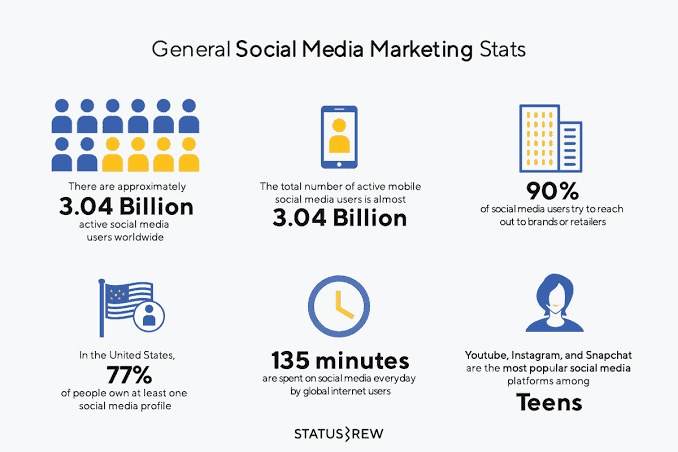
Social signals do matter a lot to Google when ranking a page. You should try to win your audience in order to make Google (or any other search engine) like you and rank you high. Especially when mentions of your brand can count as links, as we previously mentioned.
Facebook, Twitter, Google+, and Instagram are the buzzwords of the day. They’ve never been so successful and strong in their entire existence. They surely know how to engage people, provide them with the means to be inspired and cheered up, serve them the friends they need (although, most of the time, available only in the virtual world), serve them the share and like they so much crave for. However, the brands and online marketers seized the moment and saw in these social platforms the best playground for brand advocacy and promo.
Shares and likes are the new social media magic tricks. They can make your business grow and spread like wildfire. Whenever sharing the relevant, fresh, and engaging content with your community of users, you win-win new subscribers, fans, or leads.
3. Add an RSS Feed Subscription Box

It’s better to have fewer subscribers that are visiting your site on a regular basis, than a multitude of one-time visitors. This is why all the more or less reputable blogs and brands provide an RSS subscription box on their walls. RSS is short for Rich Site Summary. And I think that says it all. RSS boxes/stream RSS/channel RSS, are better known as subscription boxes, make page information available in XML format. People are drawn to the trigger-word “subscribe” and can leave their email address to receive information without having to proactively search for it on the web.
By using this type of contact form, you not only enrich your contact and subscriber agenda but also have an intrigued recipient whom you can send and communicate all your company updates, news, blog posts, etc. You can opt for this Google Feedburner.
Many times, users are so happy to benefit from continuous rich info, data, and news without having to manually look them up, and rather got satisfied when receiving them by email in the comfort of their homes or work offices. And since you might be also looking for some high-quality marketing newsletters to subscribe to, we crafted that one already, so you won’t have to worry about it.
4. Don’t Shy from Blog Commenting

There are also some minds who argue that it’s a bit delicate to recommend as it can easily turn into a black hat practice. Blog commenting is an excellent off-page SEO activity that can drive organic traffic to your website and SERP ranking.
There are loads of articles on the web on how to correctly do blog commenting and everything you need to know is one click away. But the general tone is that you should definitely do it “white-hat”, and leave any miscellaneous tactics aside.
Give your insight on topics, and attract attention to you, but don’t exercise the comment signature. Just mention your brand inside the body of relevant and useful tips, and make its appearance relevant there.
5. Guest Posting is Still Hot
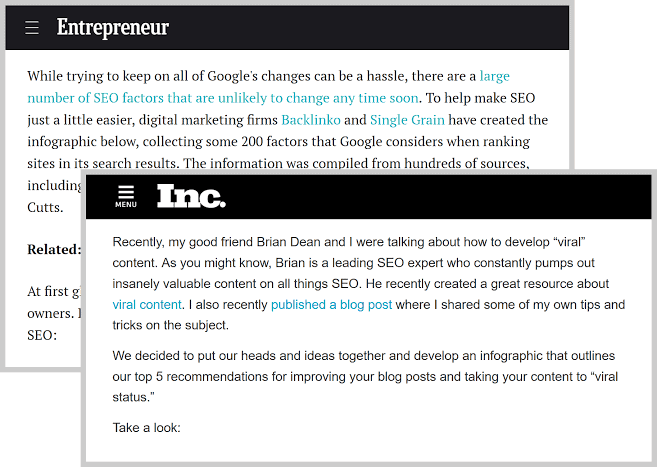
Similar to the blog commenting, you should define all your reasons for contributing in such away from the very beginning. Most guest blogs come to advertise their business or product and can sometimes turn into some spammy and annoying reading. Be fair, and make giving actionable, fresh, and relevant info your first concern. Not the links to your website.
By writing guest posts from time to time, not only help you build quality backlinks (duh!) and trigger more organic traffic to your website, but also something else. Yes, you display professional conduct by writing not only on your personal blog but contributing to others too. There are brands who like to flirt with knowledge coming from other professionals in the field, although that happens quite seldom. And that’s one of those times when you have to choose your men wisely.
6. Forums Posting Is a Thing
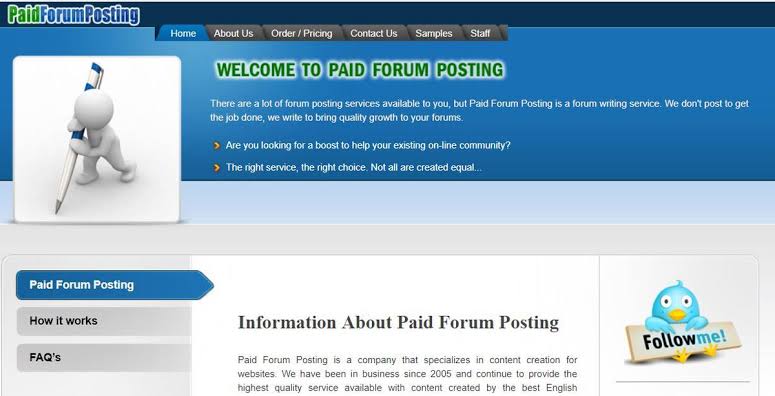
Forums are a great place to promote your website and that’s obviously part of off-page SEO techniques. Quora, Reddit, Yahoo Answers, eHow are the most important hubs from where one can gain a lot of actionable info and authentic answers to their questions. Forums are a great playground to get to meet your peers and have a chat with them on topics of interest to you.
Similar to blog commenting or guest blogging, it’s good to mention your brand, but avoid to do it bluntly. First, provide all the actionable info on the specific topic and then, if relevant, fit your brand between the lines. These Q&A platforms are true gold mines but they have to be won first, by using the right words, tone, and style when posting a contribution. Make it relevant and transparent. Especially when these mediums can bring you a lot of organic traffic to your website, and if lucky, conversions.
7. Build Trust

It’s so natural that off-site SEO includes trust as well. After all, that’s how you get your social media or customer votes. Transparency is one of the must-haves in helping trust be built. Post useful content and don’t try to deceive your readers with catchy titles and zero quality content. That’s definitely not how you build organic traffic!
Page Authority (PA) and Domain Authority (DA) are two important indicators of how search engines see your website. It’s like having your whole life in front of your eyes. You should check your PA and DA, and also your inbound links’ ones with a site explorer tool.
SSL (Secure Sockets Layer) is that setup that makes your website’s relationship with the user be safe. This type of link is making sure that the data passed between the web server and the browsers stay private and unharmed. Users trust a site more when they see that their data is secured by this encrypted link when entering private data such as credit card numbers, usernames, and passwords, or any other sensitive information.
One way to building and checking your users’ trust is to make sure you get business reviews. You can start by asking your present customers to check your rating section and leave a contribution there. It’s important to let them know how and why it’s important that you need their opinion on your services, all expressed and posted publicly. The more customers you’ll have, the more reviews you should get. Especially if you’re having a Facebook page where people can stay up-to-da about and connected to your business, and leave reviews.
8. Incorporate Videos and Images

People like to play and experiment, even if it means to play something else and they just witness it. That’s why augmented reality is a massive hit nowadays, with Snapchat, Instagram, and Facebook incorporation motion visuals projected onto the real world and driving people crazy with fascination. And all this AR is connected to video and image.
Video and images are viral nowadays, so you should bet in them. How else do you think platforms like YouTube, Vimeo (video), Flickr, Pinterest, Photobucket (photo), Facebook, Instagram, and Snapchat (video & image) have reached this far with their success story?
Off-site SEO is all about getting attention to your website, thanks to outbound activities, unrelated to your page contents. Hence you should promote your business through videos, podcasts, infographics, quotes, etc. Just take the example of Tasty by Buzzfeed or Tastemade. They’re rolling out videos like crazy and people love it, love it, love it. I bet they get more likes, shares, and bookmarks than some blog posts published by someone really good at SEO and digital marketing.
Getting back to our sheep, hub pages like Pinterest, Youtube and so on, have massive PageRank and trust, hence you should join them and associate your business with them, by using their platform to post all the stuff about your products. Given their sharing and like/thumbs up/upvote system, you’ll gain brand awareness through shares and likes.
In addition, the links that you get from YouTube videos and their meta description are extremely valuable and they help you improve your off-page SEO.
Last but not least, don’t forget about optimizing your uploaded file titles, file names, description sections, size, and links. SEO works in these niches too.
9. Build Relationships with Webmasters/Influencers

Although already mentioned this before, you should make friends among those you admire and whose steps you wish to follow in your career. Although with such a busy schedule, they’re usually willing to guide, inspire, and help. Rand Fishkin had the same message when speaking at Inbound, in 2013.
Start connecting with them, impress them enough to make them share your content and you’ve won yourself some quality relationships. But beware, you have to make sure you don’t overlook them in time, but always make sure to keep in touch with them, ask for their advice and feature them in your pieces of content. This way, your content is more bound to being shared across their own personal social channels, than random content on your blog.
10. Be Present On the Web

McDonald’s, Coca-Cola, and Bic are everywhere. There are more people who might’ve heard about them than those who’ve heard of a camera, let’s say. And that’s because their marketing strategies are unbeatable. Know how to address all customer segments, satisfy all fans, and deliver tasty and cheap food, or useful tools.
Off-page SEO techniques increase brand reputation and authority. So one should be present, live this very moment to make your brand heard. Think of easy-to-understand ways to communicate your brand to your customers and attract them with quality services. Make them feel special. Learn how to talk to all customer segments or, at least, define your target audience, instead of floating around in the marketing space with no clue whatsoever.
11. Craft a Sparkling Brand Image
Nobody wants more of the same thing. Think about what people need most and don’t get, seize the opportunity, and deliver. This is how you’ll leave customers’ memory of you, of your uniqueness and utility, and someday, of your greatness.
Just look at Buzzfeed (I’m a huge fan, please pardon my enthusiasm). They get much more attention when posting something than a random marketing brand does. Because they knew how to shine their way in a world full of tips, recipes, and did-you-knows, and stand out, even though the market was already saturated. Plus, they also knew how to address various and different customer segments.
Or Neil Patel. He’s known all over the marketing industry and probably even farther. It’s because he knew how to stand out, be original, deliver easy-to-understand messages and content, one that suits all masses, not just the ones with advanced knowledge in the field of marketing.
12. Document Sharing Is Good for You
By sharing content about your brand on other platforms you’ll be able to rank for keywords your site wouldn’t otherwise be able to compete for, for various reasons like the competition is too strong. If you think your piece of content would serve others’ interests as well, upload documents to doc sharing sites like Scribd, Academia, and SlideShare.
Treat these documents like a traditional piece of content – do keyword research and fully optimize them: titles, file names, transcripts. Place the effective call-to-action and links back to your website whenever relevant and possible.
The benefit of having documents posted on such platforms is that PDFs and PowerPoint files can’t be crawled by the search engines but these sites make them readable. In addition, you also borrow some link juice for your website, which is again, awesome.
Similar to written docs, craft podcasts and videos on your to brand topic and then upload them to SoundCloud, YouTube, etc with a transcript. The transcript is where you can help search engine crawlers to bump into your content way easier. That’s SEO, baby!
13. PR Promo Game

The more you go out in the world, the more you know and the more you’ll get known. PRactise the habit of attracting the public eye, give and host interviews, gain your influencers’ audience for your brand too. Get visible, and you’ll get noticed.
Conclusion
For a long time now, search marketing is slightly second after email in terms of top online activities. Hence, you ought to appear in SERPs when users deploy queries.

Read more: bloggeroundup.com
How to Write the Perfect Blog Posts: Body Text Photo by Brad Neathery on Unsplash
Over the years, I’ve developed a process that I follow every time I’m writing. From coming up with the idea through to a finished post.
I must admit, it’s different from what most people do but it works.
I’ve tried the conventional way of coming up with the idea, writing the body and writing the headline. But to be completely honest, this way is horrible. It leaves gaps and requires you to keep coming back to add things you’ve forgotten.
So let’s walkthrough, step-by-step, the process for developing engaging blog posts.
Write a Placeholder Headline
The first thing to do when you start to write out your post is to write a placeholder headline.
You do this so that when you’re writing the body of your post, you stay on track. It’s to give you an idea of what the post is about and to keep you from doing any of that unwanted ranting I briefly mentioned.
Staying on one topic per blog post is essential, not only for your post to succeed, but to keep plenty of content in your reserve bank. If you start talking about multiple topics per post, you’ll quickly run out of ideas and as we already spoke about, idea’s can be fucking hard to come up with.
You only want to spend about 10 seconds here. It’s a placeholder, so it doesn’t need to be perfect.
Writing Placeholder Subheadings
Starting with the subheadings before you write the body text is extremely beneficial for keeping your post streamline. It also drastically reduces the time it takes to put the post together, as you’ve already created the structure.
You need the outline of your post before you begin.
Another reason is to keep your readers engaged when you hit publish.
Remember you’re not writing a novel. All too often I see posts that are just long bodies of text. Immediately turning me off reading it.
Since you’re writing a blog post a majority of people reading it will lose interest before they even scroll down, so you want to make sure there’s something grabbing their eye. You do this by breaking up the text with subheadings (among other things that I’ll cover later).
To do this, focus on these types of blog posts:
List posts — “Top 10 tools for blogging”How to’s — “How to start a WordPress blog”Step-by-Step Guides — “A step-by-step to starting a WordPress blog”Q&A’sCase Studies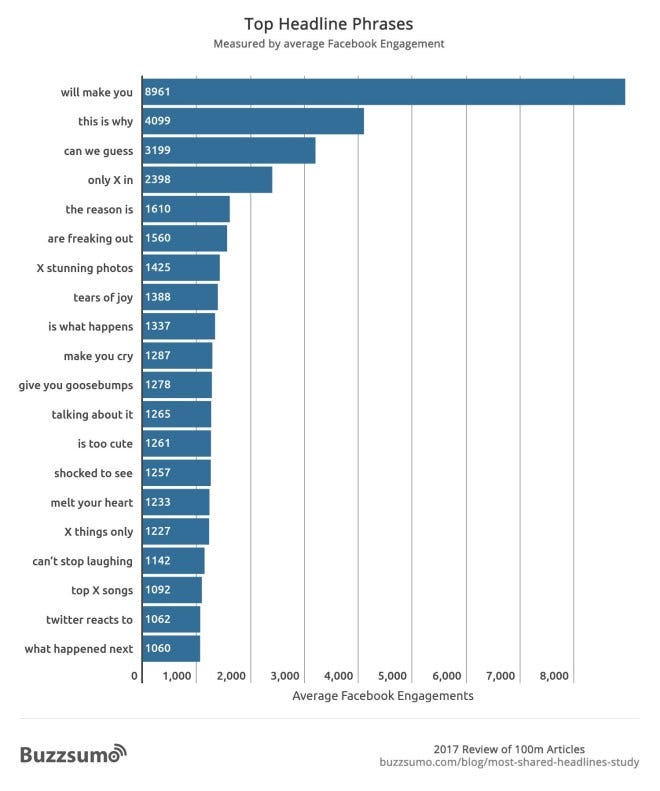
You can see a pattern. It works best for blog posts where you can pre-empt the outline.
I’ll give you an example:
Placeholder Headline: How to start a WordPress blog site Subheadings:
Buy a domain name and hosting packageUse their 1 button WordPress setupSelect your themeCreate necessary pagesWrite your first blog post
As you can see, planning out the subheadings in this kind of example ensures you don’t miss anything and allows you to expand on the subheadings. It’s the same for the other examples but note, they’re placeholders. You don’t have to stick with them. Delete and add as much as you need. It’s just a way for you to make it easier to stay on topic (this entire ebook had its subheadings written first).
Remember this one thing, readers scan at first. They look over your blog post to determine if it’s worth reading and more often than not, leave after the scan.
So you want them to get as much out of it as possible before they move one.
DO THIS NOW — write out your subheadings and make sure the reader can get everything they need to just by reading them and nothing else.
Nailing your introduction
Have you ever watched a Youtube video and the first 10 seconds is some completely out of context piece of content that has been taken out of the video because it’s the most attention-grabbing?
That’s how you need to start your blog post.
There’s a huge issue with writing in that people follow the exact structure they were taught when they went to high school.
You know the one (the one I’m moving you away from).
Introduce the topic, explain the topic, who, what, when, where, why, etc.
This style is great for press releases but it’s not for blog posts.
Make a promise now — Ignore the urge to follow the structure you were taught when you went to school and agree to always start your blog posts with something grabbing.
How do you do that?
Generally speaking, starting off with a controversial sentence or 2 does the trick. Something that people don’t necessarily agree with but would have a strong opinion on.
Here’s one for example:
Header: Don’t set a New Year’s Resolution in 2019. Do this instead!Intro: As 2018 finishes, it’s almost time to start hearing about all the amazing New Year’s Resolutions people will create for the 5th year in a row.With new hopes and beliefs that they will actually see them through. It feels great to set New Year’s Resolutions. But I’m urging you not to.
By reading that, you’re going to have a pretty strong opinion but it makes you want to read more because it leaves you asking ‘why’?
Why shouldn’t I set resolutions?
Why don’t you set resolutions?
Do you not want me to succeed?
Then as the person starts to read on they begin to learn that instead of setting resolutions, they should set goals. Which are 2 very different things and I would explain how they’re different and how to set goals.
Another example might be:
Header: The top 10 blogging tools you need to use to scaleIntro: If you’re still only using Google Analytics as your data tracking tool then your blog will never reach its full potential.There are thousands of tools out there that can help you grow your blog and while you don’t need all of them, you do need to be using these 10.
This way of starting out a blog also gives you perfect content for you to share on social media platforms and can often serve as a good Meta Description for SEO purposes.
Get them reading down the page
I mentioned that you want to break up your text. This is especially important in the intro because you want them to scroll down to the body.
To do this you need to build suspense and tempo.
This is done by using separate lines for separate sentences.
I’ll show you what I mean with a previous example:
As 2018 finishes, it’s almost time to start hearing about all the amazing New Year’s Resolutions people will create for the 5th year in a row. With new hopes and beliefs that they will actually see them through. It feels great to set New Year’s Resolutions. But I’m urging you not to.
See how you want to read the next line. It pulls you in and builds the suspense but what if I wrote it like this:
As 2018 finishes, it’s almost time to start hearing about all the amazing New Year’s Resolutions people will create for the 5th year in a row. With new hopes and beliefs that they will actually see them through. It feels great to set New Year’s Resolutions. But I’m urging you not to.
Yeah, it’s interesting, but where’s the suspense? It just looks like a big body of text.
This is a skill that I’ve picked up over time and you’ll get better at as you go.
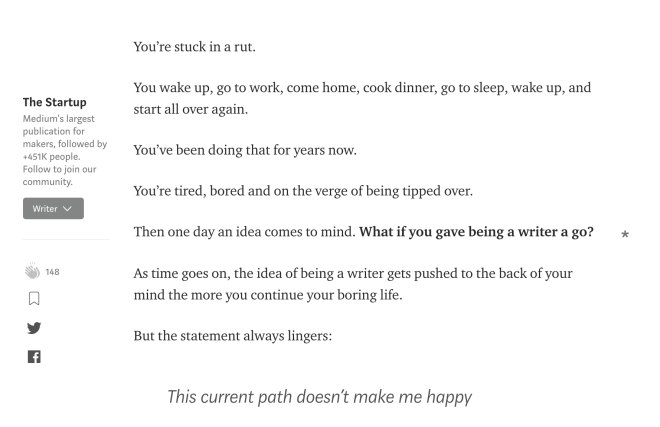
DO THIS NOW — write out your introduction. Firstly write 3–5 sentences in one paragraph, then put all the sentences on separate lines and read it over. Does it build suspense? Is it controversial? If not, try again. As I said, you’ll get better as you do it more.
The bulk of the body
Now that you have your placeholder heading and subheadings, and have nailed your introduction, it’s time to work through the body of the post.
While I can’t tell you what to write as I have no idea what you’re writing about, I can give you helpful tips to drastically improve your post.
These will work for any topic. It doesn’t matter if you’re writing about travel, motivation, digital marketing, food, animals, or whatever else, these tips are essential for keeping the reader engaged right through to the end of your blog post.
Write exactly how you talk
I know I already spoke about this point but I just want to touch on it again before you start to write the body.
You need to develop your own voice. Don’t copy anyone and ask yourself this question:
How can I stand out if I’m just like everyone else?
Okay, let’s move on.
Write the whole thing once
When the writing starts to flow, the last thing you want to do is break that.
That’s why when you start writing the body of your post, it’s important to write it all out in one session.
In some cases, I know that’s not possible. Especially if you’re post is going to be 2,500+ words. Try to do as much of it as you can in as bigger chunks as possible.
This is because of a thing called FLOW.
Flow is that state you get in when you’re so submerged in what you’re doing that anything happening around you is completely blocked out.
I can recall so many times when I’ve been in a state of flow then when I get out of it I have this faint feeling that someone was talking to me. So I’d go into my sister’s room and ask her if she was talking to me. To which I normally get the response of “Yes, about half an hour ago and you just ignored me’.
When I talk about breaks I don’t just mean getting up and getting a drink, I mean any kind of distraction that takes your mind off writing.
When you stop writing to check facts, re-read something you wanted to quote, edit or look up particular names, you take your attention away from writing and put it somewhere else. Which, more often than not, turns into checking social media, watching a Youtube video or just completely stopping altogether.
You’ll also find that in some cases you lose what you were going to say next and the blog post won’t read as smoothly as it would have if you just wrote the whole thing once.
So, remember, when you sit down to write the body of your post. Do exactly that. Sit down, write the whole thing out, then edit. Don’t break it up.
Further on, I’ll give you the best editing strategy for your posts to ensure they’re the best they can be.
Introduce the next subheading where possible
A post sounds smooth when the subheading is introduced in the previous paragraph.
Again, this is to keep the reader wanting to read more.
But get creative with it. Don’t straight up say ‘and in my next paragraph I’ll speak about….’. You want to hint at what’s to come.
Always include personal stories
Back when I first started writing blog posts I would hammer people with a whole bunch of information and advice and that would be it.
While the information itself was good, it wasn’t interesting. It wasn’t enough for people to want to read the whole thing. According to Google Analytics, they were leaving the posts within 10 seconds and my bounce rate was over 90%.
I had no idea why this was until I very luckily received an email from one of the readers.
Who essentially completely changed the way I wrote my posts.
They told me one important thing which was that I needed to include personal stories within my posts.
Ever since I have experienced much higher engagement with the posts I write.
So how do you do it?
Well exactly like I just did.
Consider it more of an example rather than a story.
The stories you include should never go on for too long and they should always be relevant to the post topic. You only want to include the most important bits of the story, while keeping it helpful.
I’ll give you an example, consider the story I just told you:
Back when I first started writing blog posts I would hammer people with a whole bunch of information and advice. While the information itself was good, it wasn’t interesting. The readers couldn’t develop a relationship with the posts and my audience didn’t grow for months. Luckily, I received an email from one of the readers which essentially changed the way I went about writing. It told me one important thing and that was that I needed to include personal stories within my posts. Ever since I have experienced much higher engagement with the blog posts I write.
Now read this version:
Back at the beginning of 2017, I started writing blog posts as a way of me releasing the emotions I was feeling with my Chronic Illness. I would watch a whole bunch of motivational videos and regurgitate the information I had learnt in a way that made sense to me with the hopes that it would make sense to others. I would write blog posts every day full of facts and information on how people could better their goals by changing the way they approached their life and their goals. I had written at least 60 articles… blah blah blah
I haven’t even gotten to the point of the story and I can bet most people would have stopped reading.
The problem with that version is that it includes way too much irrelevant information.
You need to keep your stories short, sharp and straight to the point. They should be used as validation to a point, not as the body.
That being said, if the purpose of the post is to tell a story then the body will be your story.
Which brings me to my final point.
Get rid of unnecessary words!
Most people have a habit of adding in words that don’t need to be there.
I think this stems from the need to hit certain word counts when you’re at school/university.
You know by now that in order to keep readers to stay engaged your posts need to be perfect and at any second the reader could be turned off your post.
A huge contributor to this is the constant use of unnecessary words. These words are added through unintentional habit but they need to be taken out.
Let me give you an example:
It was actually the best thing that ever happened to me.
In this example, I’ve added words to make it seem more interesting. When in actual fact, I’ve just made it longer.
It should read like this: It’s the best thing that’s happened to me.
Short, sweet, to the point.
To get you in the right frame of mind, here are some words to avoid:
JustReally/veryActuallyAlwaysOnlySimply (My least favorite. It makes the reader feel stupid)Basically (Same as above)
Start with these and re-read your sentences. Asking yourself if all the words in it need to be there.
Important points that you should remember:Your blog posts should be more than 300 words. Otherwise, they’ll be too short to attract organic traffic from Google. Ideally, they should be at least 1,000 words.List posts (Top 10…, etc) perform the best. So use them to build engagement.Remember KISS (Keep It Simple, Stupid). Tone down the jargon and huge, pointless words.Use as many big sub-headers as possible. They help to break up the text.Do the same with images and other visuals.The use of CAPS, bold, and italics can help grab the reader’s attention. But don’t overuse it or it gets annoying and loses the effect.Always include a personal story.Remember to use short paragraphs.Join the Digital Marketing is for nerds 🚀 Facebook group! Where we’re building a community of digital marketers to share, learn and grow. Helping each other write better. Join Us.
How to write the perfect blog posts: body text was originally published in The Writing Cooperative on Medium, where people are continuing the conversation by highlighting and responding to this story.
Read more: writingcooperative.com


On-page SEO is a procedure that no major service must overlook.
Websites that follow technical finest practices make it simple for search bots to discover, check out, and rank their material. As an outcome, they are rewarded with important traffic. Having the best on-page setup likewise enhances user experience, which keeps individuals returning.
However, seo keeps developing, and tracking the modifications is both essential and wise. In some cases, a minor tweak can make a huge distinction, yet we are so hectic running our companies that we ignore the fundamentals.
To assist you out, we’’ ve put together a list (in no particular order) of 25 of the most crucial elements of onsite optimization –-- things that are present, pertinent, and can have a significant effect on your bottom line. Please share, and do let me understand what I have actually excluded.
.On-Page SEO: 25 Essential Considerations 1. Page Speed.
Having a sluggish filling site can significantly minimize conversions and sales. In addition, website speed is a ranking signal. When you discover how to reduce page load time , enhance user experience by accomplishing a load time of 3 seconds or less.
.2. Material Length.
Evidence recommends that longer post are much better for SEO. A number of research studies have actually revealed that posts with a word count of 1,500 or more normally rank greater in online search engine results pages. They get more incoming links, shares, and traffic. Have a look at the supreme blogging list for other crucial points to think about.
.3. Material Freshness.
Every brand-new post is an indexed page and chance to be discovered. That aside, brand-new details is most likely to be more appropriate—-- that’’ s how Google sees it —-- and is for that reason most likely to appear in search. Upgrading old material frequently can enhance rankings.
.4. Keyword Density.
Not that essential any longer, however it still matters. Making sure that keywords are utilized naturally in material can assist pages rank. If they appear perfectly, they might bring in ‘‘ over optimization ’ charges. In either case, it pays to watch on density. Some think that a keyword rich domain name can help as well.
.5. Internal Links.
How inner pages are connected impacts site architecture, which is essential in on-page SEO yet is frequently ignored. An excellent internal link structure assists online search engine crawl and rank your websites. It likewise makes it much easier for users to browse your website.
.6. Outbound Links.
Sites that connect out (with enhanced links) to other reliable and pertinent sites are viewed by Google and users as providing more worth. Too numerous links might be translated as spammy. Think about that dofollow links can ‘‘ leakage ’ PageRank.
.7. Title Tag.
The <