
If you’ve gone into Google Analytics lately to look at your website performance, you’ll notice a large chunk of traffic and conversions attributed to “Direct.”
It’s tempting to think all those visitors came to your website because they either already know your brand, or saw some kind of offline advertising you did. But in this post, we’ll lay out a few reasons why that isn’t always the case, and what you can do to get a true understanding of your brand strength in Google Analytics.
Some Background on “Direct” Traffic
A very common misconception in digital marketing is that Direct traffic is registered when a user visits your website by typing your URL into their browser, or from bookmarking the site.
This might have to do with Google’s definition of Direct source traffic, which is as “users that typed your URL directly into their browser, or who had bookmarked your site.”
This is true, but not comprehensive.
Direct traffic is actually:
Users who type your URL directly into their browser Users who bookmark your site and navigate to it from their bookmark Users from any source where Google Analytics can’t detect referral information
That third grouping of traffic can create a black box for marketers.
We hope to shed some light into that black box and provide you with a handful of metrics and reports to better show the strength of your brand through Direct traffic.
Direct Traffic That isn’t Actually Direct
When traffic arrives on your site that doesn’t fit any other Google Analytics channel and can’t be considered actual Direct traffic, we refer to it as “dark” traffic.
Recently, Portent Analytics Architect Michael Wiegand did a study and found that an average of 17.6% of our clients’ traffic was dark.
For example, if you’re getting Direct traffic to pages deep in your website, or to URLs that would be unnatural for someone to type into a browser, then that traffic is likely “dark” traffic. Depending on the page content and volume of landing page sessions, a bookmark may also not be likely.
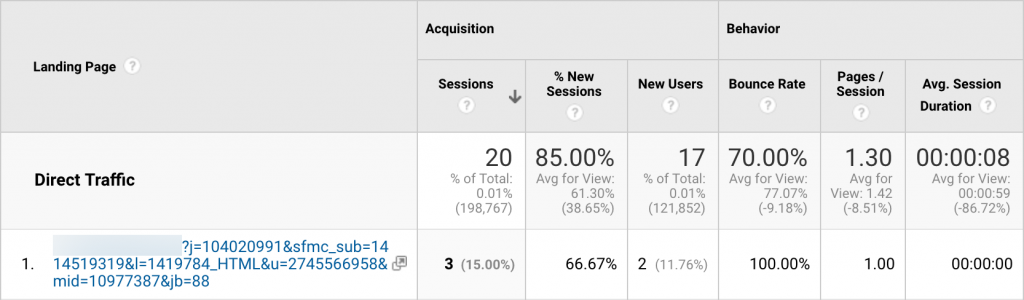

However, “dark” does not necessarily mean “bad” traffic. It simply means that Google Analytics cannot track where the user came from when they arrived on your site. The reality is that there is a growing number of reasons for this. Some examples of sources that GA sometimes cannot track are:
App referrals Text messages Incognito/secure browsing Social platforms Bots
However, there are tools at your disposal to make corrections for some of these instances. If you know you are sending traffic to your site that is not within Google defined segments, you can build your own custom segment and capture some of that misattributed traffic.
Another common source of Direct traffic comes from third-party booking sites, which can be fixed with cross-domain tracking.
Mobile traffic also tends to generate more traffic than Desktop. Redirects from HTTP to HTTPS may also break the user path in a way that Google can’t track. Even the browser you use may contribute to what Source/Medium data is available to GA. These instances are where “Direct” becomes a catch-all for anything GA can’t attribute with a defined Source or Medium.
Direct Traffic That is Actually Direct
While those caveats might seem overwhelming, it’s not time to throw out your Direct traffic metric just yet. There is obviously a good portion of your Direct traffic that is truly Direct.
Reviewing the landing pages of your Direct traffic is a good indication of what is legitimate.
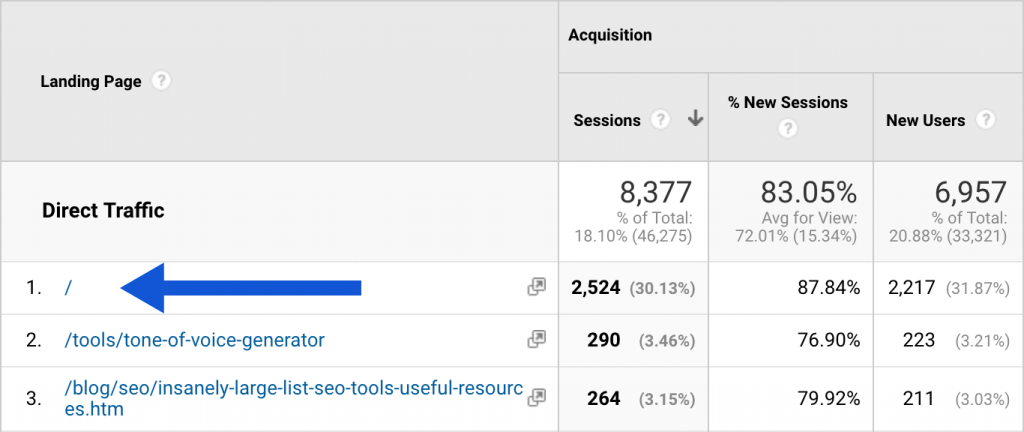

Traffic that lands directly on the homepage is likely real Direct traffic because that is what users are most likely to type into a browser. Direct traffic to other URLs with short page paths may also be legitimate traffic.
In terms of visibility, this difference in Direct traffic to the homepage could be a good indication of how well-known your brand is to users on the internet. Big brands like Nordstrom will tend to see higher volumes of Direct traffic, where small start-ups don’t see the same level of brand recognition reflected in their Direct traffic.
For example, we work with a large e-commerce retailer whose brand name is commonplace. Over the past quarter, 68% of their Direct traffic was to the homepage. For a smaller client brand, around 20% of Direct traffic went to their homepage.
Direct Traffic as a Piece of the Brand Strength Puzzle
Now that we have an understanding of the right components of Direct traffic to be looking for, how do we use it as an indicator of brand strength?
To get a full picture of brand strength in GA, we recommend combining the following sources:
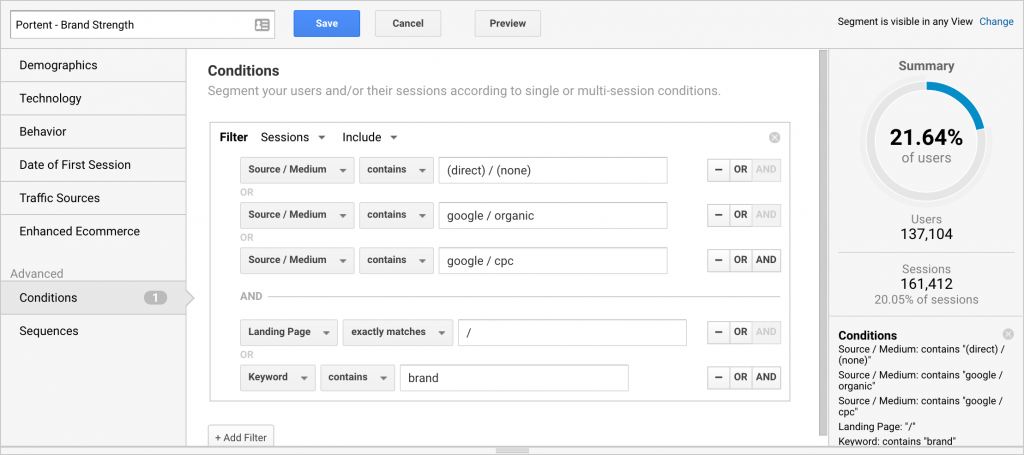
“Real” Direct traffic. Likely by homepage landing page traffic, and other pages you determine are appropriate. Organic traffic to the homepage. This captures people who type brand names into a search engine and click the homepage link in the search engine results. Traffic from Paid Search campaigns that are triggered by branded keywords. This captures the second group of brand-name-Googlers who click on paid branded ads, instead of the organic homepage listing.
We’ve built this out in Google Analytics as a custom segment, free for your use. Download it and update the “Landing Page” and “Keyword” fields to capture information specific to your company.

The next time you’re asked about brand strength, refer back to what we’ve laid out here to get an answer backed by your data. There are so many ways to gauge the strength of your brand but by using Google Analytics and understanding the appropriate indicators, you can be readily equipped to clearly answer that question.
The post Is Direct Traffic an Indicator of Brand Strength? appeared first on Portent.
Read more: portent.com
““ An increased by any other name is still a rose” ” so states the stating. The exact same does not use to business or small companies. When a name is selected it out, and marketing started, altering it is close to difficult.
.Make Puns are Punny.If provided with surety, #ppppp> Puns cause laughs. The disadvantage is, an organisation owner has to take into account if the pun lasts the test of time. Constantly think about the service life prior to utilizing a pun as a brand. Will everybody still chortle and discover it amusing a year from now? In 10 years?
.Pane in the Glass puns for business in the glasswork market Reap What You Sew laughes for organisations associated with the fabric market.
The 2 examples are common in both markets. Believe outside of the standard box if it is a pun.
.Impactful Identification.
Naming an organisation utilizing an individual’’ s name is unmemorable. If a name is special and follows a content trope to fulfillment, the exception is. If a generic name is in usage, Alliteration, rhyming, and puns are common for go-to methods.
A name is the very best totally free marketing that is readily available. Advertisements flood the Internet. If it is unforgettable, an appealing brand name brings an organisation a long method in the starting.
.Length Does Not Equal Quality.
Small services require to avoid utilizing long names. The concern is not simply with character limitations, however individuals’’ s attention period. It gets smaller sized and smaller sized as the world continues to progress at a sped up speed.
Domain names and social networks platforms are more reasons that length contributes in calling. The longer the domain, the less of a possibility individuals will utilize it to traffic into the website.
.Communicate for Convenience.
Clever and innovative are great concepts. Without directing prospective clients to items, the name falls flat. What is the business selling? What are business’ ’ worths? Research study popular culture and current patterns and a name may leap to attention.
The services or products that are on screen requires highlighting with a brand that communicates the brand name’’ s worths and enjoyable enough to work as complimentary marketing through word of mouth.
.Rushing Is a No-No.
The rush to call a company likely will trigger the procedure to drift off in the incorrect instructions. Requiring time and consideration offers the flexibility to consider the total brand name till the name pops into the brain. It makes it ripe for plucking a name from thin air.
Making a list of possible names, concepts, and ideas is a great strategy. Composing them down is a method to keep the ideas on paper while releasing the mind to continue the conceptualizing procedure.
.Difficult Trademarks.
Trademarks are odd things. Constantly examine to see if another organisation owns the hallmark to the concept of a name. It keeps an entrepreneur safe from legal action and the confusion of sharing a name with a rival. Find an organisation name that is distinctive.
Picking a name is the primary step of lots of towards success. A little idea, a great deal of imaginative energy, and individuality supply an organisation with essential complimentary marketing.
The post Name Games: What enters into calling a company? appeared initially on Social Media Explorer .
.
Read more: socialmediaexplorer.com